VPFounderStartup
Renato Valdés-Olmos
Co-founder, Noord; formerly VP of Product, Pitch; Head of Design, Grammarly; Senior Director of Product Design, Lyft
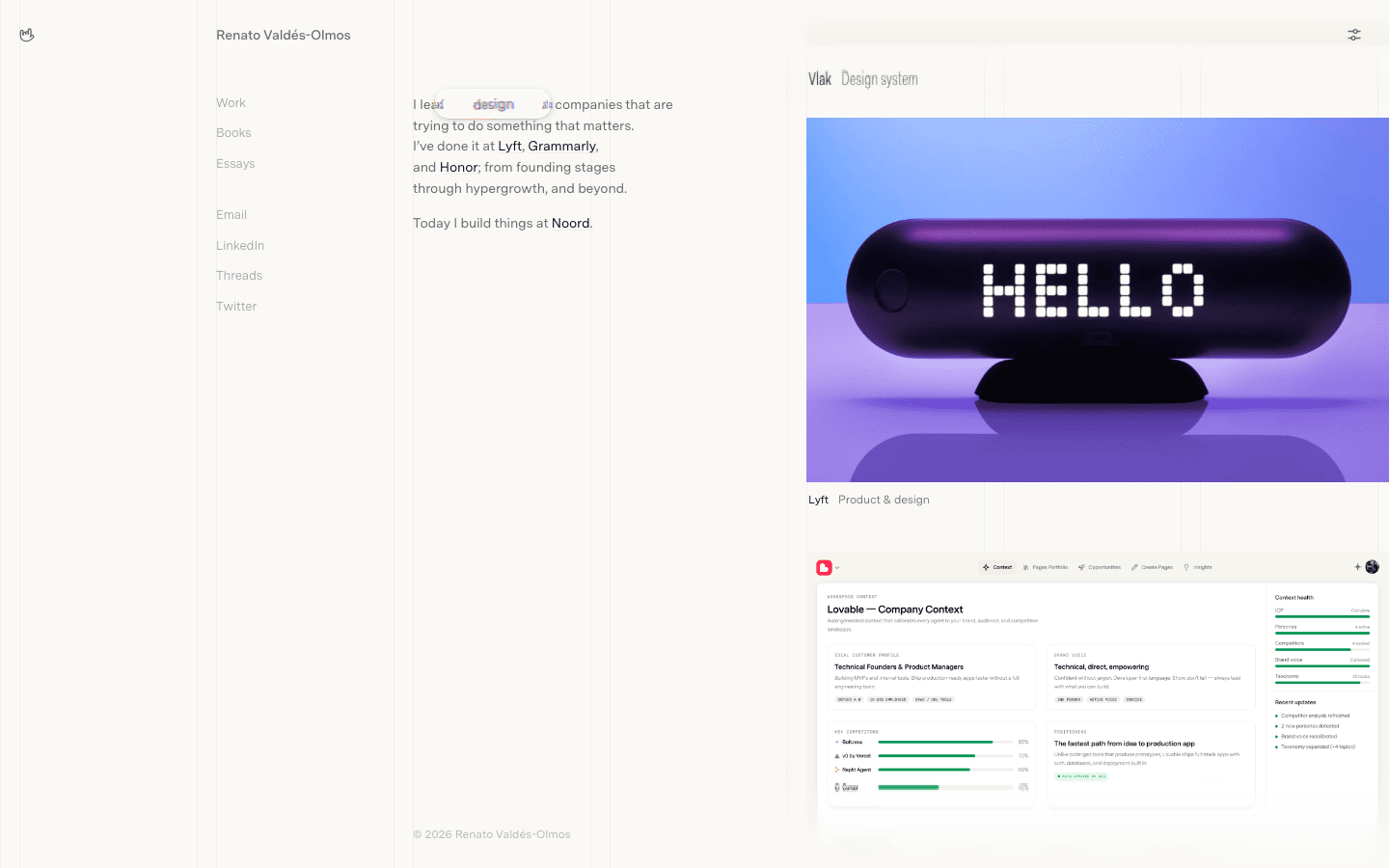
Every role stated as scope, decision and business result.
What they show
A work page organized by role, each one written as a leadership record. Grammarly, 2020: 'Built and led the design org, scaling from 5 to ~60' across product design, brand, research and design ops, for a product used by 30M+ people daily; the decision to move from browser extension toward an OS-native assistant; a $13B valuation. Lyft, 2018: as Senior Director, 'led the redesign that turned Lyft from a ride-hailing app into a multimodal transportation platform', with market share from 22% to 39% and an IPO the following spring. Pitch, 2022: VP of Product, a ~40-person org across product, design, research and brand at a $600M company, with the mandate of turning a free product into a business. Then the founder chapter: Noord, a venture studio he co-founded; GrowthX, where he's a head of design shipping production code; Vlak, an open-source design system he built himself. Below the roles, three workbooks on leveling, compensation and development, and essays on leading design. Positioning line on the homepage, with a word that rotates: 'I lead design / product / marketing / engineering at companies that are trying to do something that matters… from founding stages through hypergrowth, and beyond.'
Why it works at this level
This is the VP portfolio as a ledger. Each entry has the same four things in the same order: the title he held, the scope he ran, the decision that defined the tenure, and a business number that followed. Nothing is described as a feature; even the Grammarly tone detector is framed as part of a platform bet. That structure solves the VP problem directly: a reader doesn't have to infer seniority from craft, because the scope and outcomes are stated, and the older work carries the visual weight while the recent roles carry the numbers. The founder chapter does something most VP sites can't, which is answer the 'still hands-on' question with a shipped open-source system and production code, so the executive years and the building years read as one person.
What to steal
Write each senior role as four lines: title, scope, the defining decision, the number that followed. Put the decision in; it's what separates leading from presiding. Keep one thing you built yourself at the top of the list, even at VP, so the reader never wonders whether you can still make things.
What I'd change
One thing I'd push on. Every site here is good; this is the note I'd send the author.
The current chapter is the vague one. The homepage says 'Today I build things at Noord' with no title, GrowthX, where he's Head of Design, is filed under individual contributions, and Pitch, the biggest title on the page, never reaches the homepage at all. For a site this precise about every past role, one sentence stating what he leads now would finish it.