DirectorAgency
Pavel Bukengolts
Founder and Head of Product Design & Strategy, UX Design Lab; formerly Lead of Enterprise Design Operations & Strategy, Abbott; VP of User Experience and Web Management, Protective Life
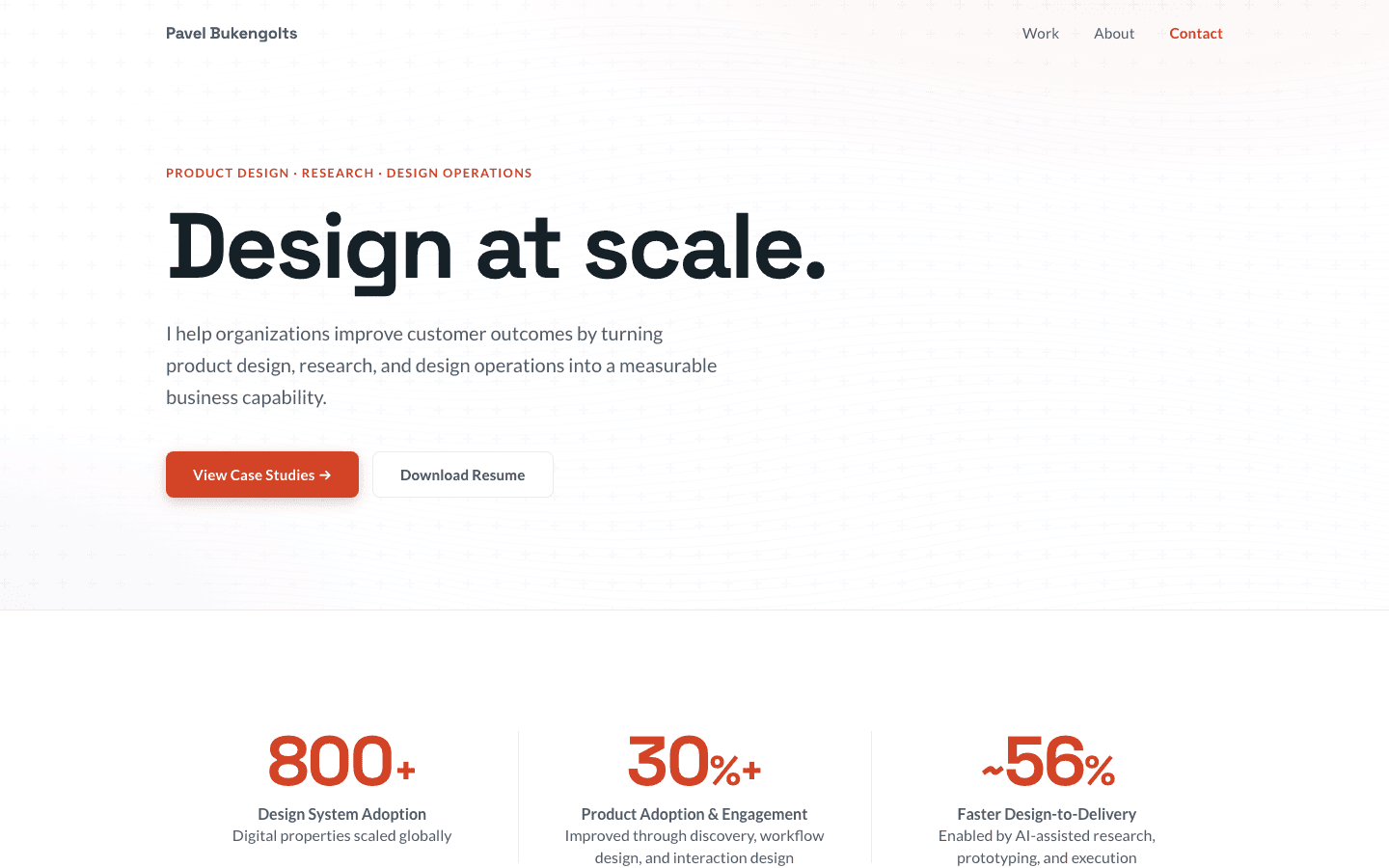
Six case studies, no client names, each with a verb, a decision and a result.
What they show
A homepage of six case studies, every card badged with a result and half the summaries opening with what he led: 'Led the strategy, structure, and governance of a design system used across 800+ digital properties'; 'Led the move from 70+ disconnected sites to a shared design system'; 'Led product strategy and field research for a fleet platform that brought 11 disconnected systems together.' The badges read 40% faster production, 56% effort reduction, 20% cost reduction, 3 beta pilots. The design system study states scope the way few enterprise leaders do: 24+ months, an internal team plus up to 40 vendor members, an APAC pilot of about 50 sites used as the business case for executive support, Sketch to Figma, a coded source of truth. Fifteen-plus years; five of the six studies withhold the client under NDA, and the sixth is his own 0→1 product.
Why it works at this level
This is the Director site for the confidential-work problem, and it solves it without a single named client. Most Director sites in this collection lean on companies people have heard of; Pavel's enterprise work is under NDA on the site (his resume places the two largest studies at Abbott and Protective Life), which is the situation most enterprise design leaders are actually in. His method is consistency: six studies, same shape, each one a leadership verb, a defining decision and, in five of the six, a business number, so the reader stops needing logos to believe the scope. The design system study shows the operating skills in full: using a regional pilot to win executive sponsorship, expanding a divisional fix into a global model, choosing an in-house solution over Storybook and saying why. Managing forty vendor staff is a scope most portfolios never mention. And the outcome badges on the cards let a reader scan the whole practice in ten seconds and still leave with numbers.
What to steal
Open every case study with the verb that names your role, then the decision that defined it, then the number. If the client is under NDA, state the scale instead (800+ properties, 40 vendor staff, 24 months); scale is more persuasive than a logo. Put the outcome on the card, not just inside the study.
What I'd change
One thing I'd push on. Every site here is good; this is the note I'd send the author.
The homepage says he's open to senior leadership roles, which is the right message, but it's the last thing on the page, and the jobs behind the work live only in the resume PDF. A Director reader wants to know what he inherited and what team he ran: the design system was an in-house role leading a team and up to 40 vendor staff; the 70+ sites were a VP job that grew a UX function from one person to ten. Put the roles, tenures and team sizes on the first screen and let the case studies hang off them. Right now the site reads as a consultant's, when the record is a line manager's.