DirectorBig Tech
Emily Campbell
Director of Design for AI Models at Figma; formerly VP of Design at HackerRank and Sr Director, Product Design and UX Research at Vendr
A role timeline where each line carries a working product fragment.
What they show
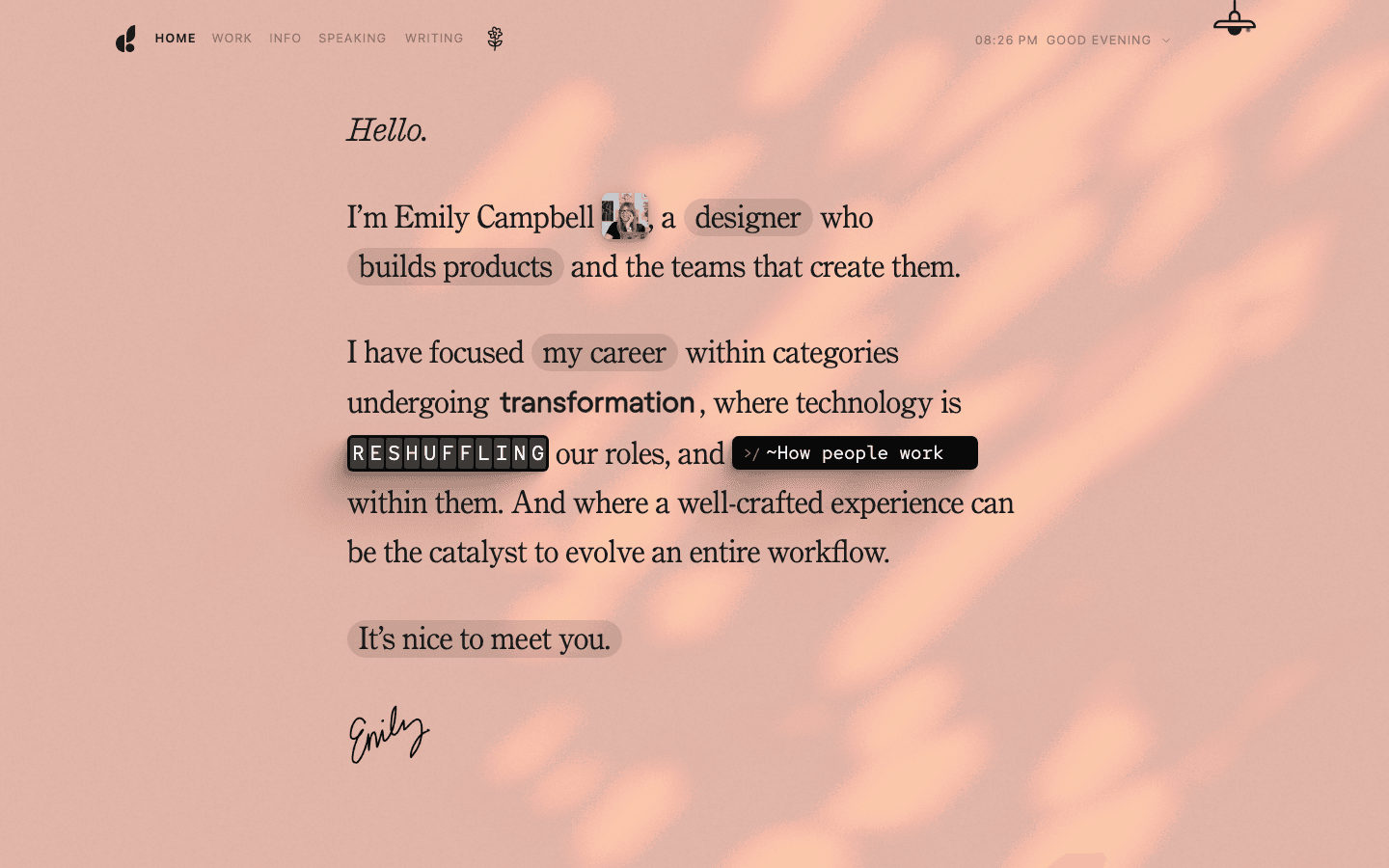
The site is organized by role, not by project. The Work page lists six roles in reverse order, from Director of Design at Figma back to Degreed. Each has company, title and dates (Degreed excepted) and two to four lines built on leadership verbs: led, directed, co-founded, facilitated. Instead of linking out to case studies, each line carries a small working piece of the product inline: a terminal install command for Chakra.sh at HackerRank, a bid request widget at Vendr, the book covers from BookClub's beta. The only numbers are BookClub's thousands of organic signups and the eight-figure accounts at InVision. The homepage thesis is one line: she is "a designer who builds products and the teams that create them." The Info page sells advisory and fractional work, and The Shape of AI, her public pattern library, sits off-site as proof of thinking.
Why it works at this level
At Director and VP level the unit of the portfolio is the role, and the reader is usually an executive scanning for range, not reading long case studies. This site is built for that reader. The whole career fits on one scroll, and the arc carries the argument: product designer, design-practice consultant at InVision, founder, then design leadership at three AI-heavy companies. The inline fragments do the work a case study normally does, proving each product was real and specific without NDA clearance or a long write-up. The Shape of AI, maintained in public, supplies the evidence of judgment that the role entries leave out, the same NDA workaround the strongest VP sites in the collection use. The craft of the page itself signals that this Director still builds.
What to steal
Put one small, working artifact next to each role instead of linking to a case study: a code snippet, a UI widget, a screenshot that moves. Write every role line with a leadership verb and an object you can point to. Keep one public body of work, like a pattern library or newsletter, that shows your judgment where the day job can't.
What I'd change
One thing I'd push on. Every site here is good; this is the note I'd send the author.
No role says how many people she led, how many managers reported to her, or what the team owned. A Director entry with no headcount leaves the reader guessing at scope. One line per role covering team size, disciplines and reports would fix it. Flags: the Info page's meta description still lists HackerRank as current, and the Degreed role has no dates.